tungwaiyip.info


home

about me

links

my software

Media

Yucatán Photos

St Lucia Photos

Photo Album

Videos

Blog

< July 2009 >
SuMoTuWeThFrSa
    1 2 3 4
5 6 7 8 91011
12131415161718
19202122232425
262728293031 

past articles »

Click for San Francisco, California Forecast

San Francisco, USA


Angkor Travel

I have spent this evening travelling in the ancient city of Angkor. Unfortunately I am not able to set foot in this land yet. Instead I have visited Angkor virtually using Google Earth from my home. It is a small pity that I wasn't going there personally. But what an incredible experience does Google Earth provide! The aerial image gives me so much intelligence on this distance land that even travelling on the ground cannot achieve. He go here.

All this was prompted by an article on the collapsed of Angkor on the current issue of National Geographic. I launched Google Earth to find an image of modern day Angkor to compare with the illustration of a historical map. The glory of the 13th century city is still clearly visible from the satellite.

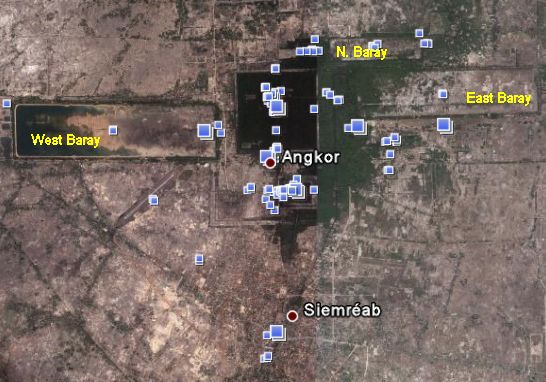
Angkor aerial view

The square at the center is the site of the ancient capital Angkor Thom, now filled with dense jungle in dark green color. The surrounding area are fields with little population. Siem Reap to the south is the only population center today. The most striking features on the map are several large rectangles. I have labeled three of them, the West Baray, East Baray and North Baray. They are actually enormous reservoir built in ancient time. The largest one West Baray measures 2 x 8 km. Today they are mostly filled up. There are still water in the west side of West Baray. Otherwise they are filled will fields. There are even roads and houses built within the Baray. National Geographic has suggested the failure of this water system during a mega-drought period is one reason for the decline of Angkor.

You can also find clusters of blue dots on the image. They point to pictures uploaded by users. These are actually enormously useful information. First of all you cannot fully understand the area by looking at the aerial picture alone. The user pictures give you detail ground level view and help you to understand some geographic features spotted from the sky. Secondly it tells you where tourists are going! An area with a dense cluster of blue dots are picture worthy places. This is an instant travel guide constructed automatically!

Since Google Earth has come out a few years ago, it has helped me so much in learning about places and geography. It is a really revolutionary tools!

2009.07.03 [, ] - comments (0)


Travel Map

I have a lot of fun with this Travel Map application. It allows you to mark on a map all the place you have travelled to. I have diligently checked off every town I have visited whether it is big or small. It ended up with just over 200 places so far! Well the number is really a little be inflated because I have check off dozens of small communities within two hours drive from my home in California. Still it is a fun exercise.

Wai Yip

I did made some serious effort to recall many small towns I have been to. I flipped though some old journals and researched for some places on the Internet. Part of the fun is it helped me to revisit some happy memories in the past.

2007.11.01 [] - comments (0)


St Lucia

Just came back from a vacation from St Lucia. The sun and water is great. But it is a little crazy for me to bring my toddler son to the Caribbean island on a 14 hours trips over a total of 5 legs of flight. In anycase he did well on the plane and was asleep most of the time. We have a good time on the beach and going to boat tours. Our trip pictures are now online!

2007.10.12 [] - comments (0)


Safe travel destinations?

When I am planning for travelling, especially to some more exotic destinations, the discussion is often steered toward the question - Is it safe? The underlying concern is the place maybe crime infested or perhaps an active target of terrorism. To the more experienced travellers this is often rejected as an undue concern. The standard rebuff is New York and LA has a higher crime rate than that of the destination.

Yet this question never goes away. People do not assess risk objectivity but base on some impression that can be very biased. Probability is such a thing that is hard for ordinary people to grasp rationally. In case of travelling, I find that the perceived risk is inversely proportional to the familiarity of the destination.

Consider New York, London, Madrid and Bali as examples. Each of them have subjected to multiple terrorist attacks. When Bali was bombed in 2002, some people discount it as an one-off incident. When it was bombed again in 2005, people are really scared and tourism plummeted. In case of New York and London, except the first few weeks after an incident, I have not heard anyone want to avoid them due to safety concern. Madrid sit somewhere in between. People perceive it as more risky than London but less risky than Bali. The perceived ranking or risk is roughly Bali > Madrid > London > New York.

Rather than base on any objective risk assessment, I think this is more a factor of familiarity. The ranking of familiarity for many outsiders are roughly New York > London > Madrid > Bali. Ask anyone in the world their impression on New York and London, they are likely to come up with hundreds of images - Statue of Liberty, Big Ben, multinational companies, the British royalties, celebrities and politicians, media and art references and their long and colorful history. This create an air of excitement that easily drown out the relative few violent incidents happened. On the other hand what do people know about Bali? Some superficial images of beach resorts and sightseeing spot? Unfortunately, for some people, the bomb attacks actually jump in front as their primary image of Bali. News of terrorism travel far and wide while domestic affairs receive little attention elsewhere. So the few incidents easily dominates outsiders' impression of the place.

The bottom line? Subjective risk is often very biased. The more familiarity you have with a place the less risk you will perceive.

2007.09.20 [] - comments (0)


Home Coming - Asia Trip 8/8

About 150 km to the west of Guangzhou is a rural community known as the village of Tung's clan. This is my ancestral homeland, the place where my father was born and raised. Although he has left for Hong Kong with a few brothers and sisters when he was young, they still maintain strong connection and return regularly to the village. On the other hand I am an urban boy born and raised in Hong Kong. I known very little about the village besides the occasional stories from my parents. I have only make one visit when I was small. I remember very little about the trip beside an impression that the village is a dirty place.

After so many years I suddenly have the urge to visit my village on the way. This was the last stop before I return to Hong Kong. I met with my parents in the nearby city Zhaoqing. It was many months since we have last seen each other. We shared a hotel room and went for dimsum the next morning before making the trip to the village.

Family Shrine

We are hosted by our cousins and nephews. They were really glad to have us visiting. It is not often for them to have guests in the village. So our visit has created some festive atmosphere. They have already finished harvesting the year's rice crop. So my nephews have a lot of free time to show me around. I have visited Tung's family shrine. The building was once collectivized but the ownership has since returned to our clan. What remains is a rather barren building.

Harvesting

I must have learned lot more about the world. My village does not seem so dirty to me this time. After a few weeks in China's backwater countries, even the squat toilet there failed to shock me. On the other hand, life remain poor in China's rural communities. For young people, the village seems to have little to go for.

* * *

From Zhaoqing I have temporary parted with my parent to take the high-speed ferry home. They would rather return by train because it only costs half as much. But after living minimally for weeks, this last trip is an easily justifiable splurge for me. After all it was an emotional moment. I wish to end the trip in a more romantic way.

The ferry ride can be described as calm and uneventful. We were seated comfortably inside the sealed compartment. Hong Kong movie was played during the trip. It has been a long time since I was surrounded by Hong Kong people all speaking Cantonese. Somehow this didn't feel so exciting.

As the ferry approaching Hong Kong, we sailed pass the site of the new airport, the new suspension bridges and finally the Central reclamation area. Upon landing at the China Hong Kong City terminal, I headed directly to Tsim Sha Tsui's waterfront promenade, to see the harbor, and to feel Hong Kong.

1996.11.17


2007.09.03 [, ] - comments (0)


China - Asia Trip 7/8

Yunnan 云南

From the border town Hekou, I took an overnight train to Kunming, the capital city of the Yunnan province. Unfortunately the sleeper tickets have already sold out. So I have to sit tight in the hard seat coach for 16 hours. Fortunately this train was not crowded and it turned out to be not as tough as I expected. This section of railway is one of the most scenic routes people ever built. The train twisted slowly along the beautiful canyons, going through many bridges and tunnels in this mountainous terrain. I was marveled by the scenery until the night has fallen.

The train pulled into Kunming station at 6 am. It was still an hour before dawn and the temperature was very chilly. Indeed it has remained gloomy and cold for rest of the day. From Kunming I have planned to first take a detour to the west to see the ancient cities of Dali and Lijiang, then return here and continue the eastward journey on to Hong Kong. The overnight bus connection to Dali would not leave until the afternoon. So I have spent the few hours of layover wandering in the city, changing money, making phone calls and shopping. Yes, shopping! The city seemed to have an amazing array of consumer goods available at rather low prices. Over the years, China has come from a country of scarcity to become the new shopping paradise!

In Kunming, I have first experienced the developing country's cultural shock, the squat toilet! Once I got off the train, I went to the train station's busy public toilet. What I saw is basically a common trench with compartments partitioned by low walls on top of it. In the trench were many days of deposits accumulated. After traveled for a full day without using the toilet, I was in no position to object. So I did what I have to do - quickly! This was the initiation of what I would accustom to for my next two weeks in Yunnan. Only until I arrived in Guangxi would I see a flush toilet again.

1996.10.26

Dali 大理

It was cold and rainy in Dali when the bus dropped me off at dawn. The young attendant was still asleep when I arrived. I woke them up to check in. It was a nice and relaxing place with a large garden, pavilions and a Thai style bistro. The rate is only US$1.25 per person. It is certainly one of the cheapest place I have stayed.

The ancient Dali was once the capital of the Dali kingdom in the southwest China. Today it is a small town with charming old houses and cobble stone streets. It is beautifully situated with the Erhai Lake in the front and the Cangshan Mountains at the back. There is a tourist street where you can find cheap hotels, street side cafés and handicraft shops. There are so many tourists strolling up and down that locals nicknamed it "Foreigner's street". Also interesting is the market in the nearby town Shaping. The market is held on Monday in a large open area. They sell everything from grains, meat, cooked food, cloths to handicrafts.

I climbed the Cangshan Mountain to visit the Zhonghe temple. Unbeknown to me, a new cableway has constructed to bring tourists from Dali to the mountain. Indeed the cable lift sometimes passes directly over the hiking trail so that I could overhear the conversation from above. Zhonghe temple itself is a neglected little place at the cableway's terminal. Perhaps more interestingly is a foot path I found that extends in both directions across the mountain. The stone path is craved from the cliff and passes through many gorges and waterfalls. From there you will find a panoramic view of Dali and the Erhai Lake. I spent half a day exploring the path, which seems to go on as far as I can see. Then I came down by the newfound cable lift. The slow ride down affords a great view of the area.

The other day I have rode a bike to Erhai Lake and Xiaguan at the far end of the lake. It was a bumpy 3 km ride to the shore by a cobble stoned road. The ride was really not worth it as I find the shore a rather unattractive place. Luckily the rest of the trip was very good ride on a newly paved road run parallel to the main road. In Xiaguan I found the Erhai Park a pleasant place. It has an open view to the lake and the mountains. The spaciousness is a great relief to the crowded cities.

1996.10.30

Lijiang 丽江

The ancient city of Lijiang is in a valley floor amid the rolling mountains of Yunnan. Its well preserved old town is a real gem with old houses and cobble stone streets and a market square in the middle of the town. Open streams crisscross the city. People draw water for drinking and washing from these fast flowing streams. It seems surprisingly clear considers it is used by so many people.

Lijiang

The city has experienced a major earthquake earlier this year. People have spent an unforgettable Chinese new year camping outdoor in snow after the quake because of the danger in a damaged buildings. Although many buildings have already been restored, others were simply marked for demolition.

My bus from Dali to Lijiang ran thought a mountainous area. It has run into an unexpected problem and has broken down halfway amid the mountains. The driver flagged down a bigger bus for us. Despite it was already full, all of us managed to squeeze in somehow. When I finally arrived in Lijiang, I was again greeted by rain. Fortunately the weather was fine after that.

I stayed in the Lijiang hotel. The hotel has a shiny new wing used mainly by Chinese visitors. Foreign backpackers and myself, however, choose the old fashioned, communist style, blockish old wing. The dormitory I have stayed has 30 beds spread in a large hall. But it was only occupied by a few people. Other than the Karaoke music from the neighbor which went well into midnight, the dormitory is really not a bad place to stay.

Many inhabitants of Lijiang are of ethnic Naxi. They have developed an interesting looking pictographic written language called Dongba script. Many shops in the old town used it for their shop's sign. I also attended the performance of the Naxi music orchestra. The performers are mostly elderly over their 70s. The conductor Xuan Ke was a humorous man. He told stories in both Chinese and English of how they suffered and survived in the Cultural Revolution. He is very proud of his orchestra for preserving the ancient Tao music, which has originated but has since lost among the Han Chinese.

I had a great bike trip to Yunshanping, a plateau at the foot of Jade Dragon Snow Mountain (玉龙雪山), about 30 km away from the city with a steep climb. The weather was beautiful. Riding a lone bike along the lone road, I saw only shrubs and pine trees on this vast plateau. I love the emptiness and the solitude there. So there was quite an irony when I saw a Chinese sign elected on the road, proudly proclaim that "We will develop this place and push tourism into a new era"! Unfortunately on my way back I ran into a strong head wind. So strong that it turned the thrill of running down hill into a labor.

The sight of Jade Dragon Snow Mountain, standing tall at 5500 meter, dominates the Lijiang area. But its elusive peak does not reveal itself easily. Even on the sunniest hour the peak seems always hidden in cloud. Sometimes I just sat in the hotel to stare at it, hoping for the last patch of cloud to disperse. But I had no luck to catch a glimpse even after an entire week there.

1996.11.07

Tiger Leaping Gorge 虎跳峡

Tiger Leaping Gorge is one of the deepest gorges of the world. From the top of the mountain to the roaring river below it is almost 4000 meter deep. There were few tourism infrastructures available and no vehicle access. A demanding trail of about 30 to 40 km passes through the gorge from the town of Qiaotou at one end to Daju on the other end. Most people spent an overnight in the Walnut Grove village in the middle. The trail is often subject to natural hazards like landslides. It was further aggravated by the recent earthquakes. The gossip in Lijiang gave many people a second thought if it is safe to go. Indeed the Japanese roommate in the Lijiang Hotel has just turned back from there midway because the trail was washed away by a major landslide. To go or not to go, I have struggled over it for a long time. At the end I am very glad that I have made it, for it is one of most majestic place on earth.

Tiger Leaping Gorge

The bus departed from Lijiang was bumping on a bad road for a full hour before climbing over a mountain pass. From there it opens up to a great view of the Jinsha River, the upstream of the Yangtze River. The river makes the first bend at Shigu and then flow into the gorge. The bus continued rolling for another two hours on the winding road before it finally arrived in the grayish town Qiaotou.

I have spent a night at a pleasant guesthouse. Being the only guy I very much hope to meet other tourists for the trip. But Qiaotou is not like a national parks headquarter. Hardly any people seem to go there for leisure. By the time I set off at dawn the next day, it was clear that I was going to make the trek by myself. Only until half way would I finally met a villager. He was very kind and we joined for the rest the way.

* * *

At the entrance of the trail to Tiger Leaping Gorge is a toll booth. Funny how I have started so early that it was still not manned. So I just kept the 10 yuan toll. The trail begins with a long climb passes several villages. One thousand meter below my feet is the roaring water of Jinsha. On the opposite side is a vertical cliff of the back of Jade Dragon Snow Mountain. As I was progressing I looked back frequently and found myself getting deeper and deeper into the gorge. Finally I was deep enough that I could not see the outside anymore. Once I was on the trail I found the safety concern a bit overblown. It is no more challenging than any other trails I have been to, except of course this is in a very dramatic setting.

Tiger Leaping Gorge Trail

I have arrived in Walnut Grove by early afternoon. The small village in the middle of the gorge has two guesthouses. I was the only visitor in my guest house that day. The adult owner, who is also a farmer, was working in the field when I arrived. His 12 year old daughter was left to run the place and attended me. More visitors have arrived next day and place become livelier.

The guesthouse is fantastic. Outside is an outdoor café overlooking the cliff (in rural China's terms, an outdoor flat space with some rustic furniture). The village was small, quiet and peaceful, an enchanting place that fits Shangri-la. I realized how silly I was to be preoccupied with the physical challenge of trekking through the gorge. This village should be the destination! No longer was I concerned about completing the trek tomorrow. I just stayed in the village for an extra day. Actually I regretted to have packed ultra-lightweight and left many essentials in Lijiang in anticipation for a tough trek. Otherwise I would have stayed much longer.

Sean&aposs Spring Guesthouse

I have spent some time exploring the area. From the village I have descended to the river. It was not too difficult but it did involve some climbing over big rocks. Down there the powerful river was storming the boulders making thundering noise. I have also gone scouting with the guesthouse's owner, Sean, for an alternate route to Daju. The problem of that time was that part of a trail was destroyed in a landslide (that was the reason the Japanese friend has turned back). To bypass it, a detour was made by moving a boat crossing further upstream. Ironically the new crossing used to be an impassable rocky shallow. It has only become navigable because the landslide has dammed the river and raised the water level. This is the testimonial how the nature continues to shape the gorge. When we left for the next day, we have the distinction to be the first tourists to trek through Tiger Leaping Gorge by the new route since the landslide.

Reluctantly, I moved on by the third day. This time we were in a bigger convoy with the two girls I have acquainted plus the owner of the rival guesthouse. We descended to the water along a steep and zigzagging path. The descend route is actually one of the best place to appreciate the vastness of the gorge. We crossed the river by boat and then climbed back onto a plateau on the opposite side. Looking back, the zigzag path appeared as a crack on a vast cliff face. Here we have already exited the gorge. The owner accompanied us as far as the opposite shore of the river. But the boatman was very kind to accompany us all the way out. It was another 2 hours of walk from the plateau to the village of Daju.

1996.11.04

Kunming 昆明

After two wonderful weeks in Dali and Lijiang, I went back to Kunming by bus. I stopped at midway in Dali to break up the long trip. I went back to my old favorite café to sip some coffee. While I have left for Lijiang for a week, I was delighted to found many old pals I first met one week ago were still staying in Dali. Later I left for Kunming by another sleeper bus. In the midnight the bus had a minor crash with a different bus. This resulted in a crack in our bus' windshield. It was a miracle that we get back to Kunming with only two hours of delay.

Kunming didn't give me good impressions on my second arrival. The bus spent much time in bad traffic in the morning before it was able to pull into the terminal. The first thing happened when I got off the bus was I stepped into a stagnant pond of water. The crowds and noises of the city were overwhelming to me. I escaped Kunming after staying only for one night.

After settled down in the hotel, I went to the West Hill for sightseeing. But after Dali and Lijiang, the sights in Kunming are pale in comparison. The West Hill does have a view of the Dian Lake, though it is no comparison to Erhai. The Taoist temple at the Dragon Gate and the tunnel craved in the cliff is a work of marvel. But there were just far too many tourists packed in a narrow passage for me to truly appreciate it. Chinese tourists go to sight seeing spots to pose for pictures. I was constantly getting in the way of pictures and they were not hesitated to ask me to make way.

Shilin (Stone Forest) is an area outside of Kunming famous for the many towering limestone spreading in the region. I have joined several others for a day trip by a shared taxi. Upon arrival I found Shilin almost like a theme park. The main park has so many improvements, like paths, railings and pavilions, built right amid the stones that it makes nature looks artificial. Loads of tourist are posing for pictures and making much noise. Even if I tried to get away in the labyrinth of pillars the noise echo around and reach everywhere. It made me wonder maybe I should not come at all. Fortunately Shilin is very large. All I need to do is to walk away from the main park. Further across the grassy field are several different groups of stones. There one will find no artificial improvements and no noisy tourists. Only then was I able to truly appreciate the Stone Forest as a natural wonder.

I returned to the hotel room in the late afternoon. Although I have already checked out in the morning I was sneaking back for a shower. My bed in the dorm room has already occupied by a new guy. But two previous roommates were still there. I had a good chat with the guy from Namibia before leaving. This conversation was perhaps my most positive experience in Kunming.

1996.11.09

Huangguoshu Falls 黄果树瀑布

My next destination Guilin is 30 hours away by train. The sleeper ticket was in such high demand that it was out of question to get it in short order. Hard seat ticket was still available. But rather than sitting 30 hours straight, I have decided to stop midway in Guizhou to visit the great Huangguoshu falls. This way the long trip was broken into two shorter legs that were less wearing.

The weather was again gloomy and rainy when the train arrived in Anshun station. The town does not look like an attractive place to stay. So I have decided my visit to Huangguoshu is only going to be a day trip and I would leave in the evening.

I often took advantage of overnight transportation to save on hotel expenses. This time I really pushed it to the extreme. Out of the four nights, three were spent on transportation. The first night on the bus from Dali to Kunming, then a night in a hotel, another night on the train to Guizhou, and this night on the train to Guilin. I have covered a long distance in a rapid pace. Yet I still managed to visit many major attractions on the way. If you ask me about shower, I have to say I did not have the opportunity to do it everyday.

I joined the minibus tour to Huangguoshu operating right in front of the train station. Being a rare Hong Konger makes me an interesting subject on this bus. Fellow mainlanders were very curious and asked me all sort of questions. They were particularly enthusiastic about Hone Kong's return to China in 1997. However they were disappointed that the border control would remain and they still cannot travel to Hong Kong freely after 1997.

Huangguoshu Falls

Our first attraction in Huangguoshu is the Tianxiang bridge park. It has a stone path that leads us through a series of minor waterfalls and lakes. There were so many tourists that it just reminds me of the touristy part of Shilin. The only thing interesting is the cavernous cave that we went next. However I was bothered by the strong spotlights setup inside the cave, presumably to make photography easier inside. I suspected that is also the cause of high temperature and stuffy air inside.

We went on to the main waterfall in the afternoon. At 77 meter high and 77 meter wide, it is an impressive fall. Again there were many tourists there all busy posing for pictures. From above, trails and tunnels bring us to up close to the falling water. Finally a path leads us to cross the fall behind the water. I had fun, got wet, but somehow felt it was anti-climax.

* * *

From Huangguoshu I went to the Guiyang train station in the evening. When I saw the crowd outside the station, I knew I was getting in trouble. Although Guiyang is a major city on the busy Kunming-Guangzhou rail line, trains were all full when it arrived here. Not only was it impossible to get a sleeper ticket, I cannot any ticket at all. I braved through the crowd to reach the ticket window, only to find it mostly unattended. When the attendant occasionally returned, she only minded her own business and entirely ignored me asking question in front of the window. Desperately I turned to the only viable source, the black marketeers in the station. I paid them a few times over the official fare for a ticket. But that bothered me less than the risk of end up with a fraudulent ticket. Unlucky I managed to get on the train without problem. Like most major train stations in China, Guiyang station was busy day and night. The waiting room only opens for passengers whose train is about to depart. My departure time happen to be 1 am. That means I have a few hours to spend but no place to go.

By midnight I have managed to get on the train. My ticket did not come with an assigned seat. Just as I have feared, the coach was completely full. Facing the prospect of standing overnight and for all 18 hours of the trip, I was surprised to find out there were black marketeers trading seats too. Although they seemed to be dubious people, I still paid them for the privilege. All the time I have worried a rightful owner of the seat might turned up to challenge my right.

Once I settled in, the journey has only just begun. Sitting overnight was one thing; dealing with the awful hygiene and rough people was another matter. Passengers conveniently threw trashes like fruit peels and peanut husks straight to the floor. Spitting on the floor was prevalent and was practiced by all five passengers sitting around me. Every once in a while the attendants would sweep the floor and invariably it snowballed into a huge pile of trash. Verbal fights broke out among passengers from time to time. In the midnight I was awaken by the commotion because a thief tried to steal from a passenger asleep. Even as he was caught he has not backed down and it almost ended in a fist fight. What a tense night on a train!

Such is the time when being a solo traveler is especially vulnerable because you have nobody else to fend for yourself. I hold off using the restroom for the longest time because doing so would surrender my seat and no one was looking after my baggage. The time on this slow moving train seemed to last forever. I was counting hours and constantly trying to boost my spirit, reminding myself there will be the sunshine at the end of this.

1996.11.10

Yangshuo 阳朔

Finally I got off the train in Guilin and then transfer to another minibus for Yangshuo. It was rather late when I got there. But at last I have survived that awful trip. I checked myself into a decent hotel and was delighted to find that it has a flush toilet, something I have not seen for a long time. I treated myself a nice meal and a beer at a café before going to bed.

Yangshuo is a small town but it has a niche of foreign tourists. The tourist street is lined with roadside cafés and souvenir shops. Some cafés has evening movie shows for western movies. It reminds me of Bangkok's Khao Shan road except it is much quieter here.

The town is right on the Li River, where people go to see the famous Guilin scenery. The water is shallow but exceptionally clear. The Li River boat trip is a big tourist attraction. Along the river we saw all kinds of peculiarly shaped hills and rocks. These karst formations are actually abundant throughout the Guangxi province and Guizhou province. But on the Li River the sight combined with its reflection on the river forms a particularly poetic scenery.

Yangshuo

The next day I planned to bike to the nearby Moon Hill. It is some distance from the town and the direction was sketchy. I have some doubt if I could find the place. But once I went out in the country I find it impossible to miss. The Moon Hill was out there on a wedge shaped hill punctured by a big round hole that gives it the name! I biked to the hill base, climbed to the hole and finally over to the peak of the arch above. Nobody was there and I have the hill all by myself. From the top it offers an excellent view of the area.

Yangshuo was essentially the last stop in my trip as a tourist. Although I do not have any commitment afterward, I have not lingered on any longer than the three days I have planned. Yangshuo is a nice place. But I did not have the same kind of attachment as I have found in other places. I was grateful for what I have seen and done so far. It was about time for me to complete the journey.

1996.11.14


2007.03.04 [, ] - comments (0)


Flight Over The Arctic

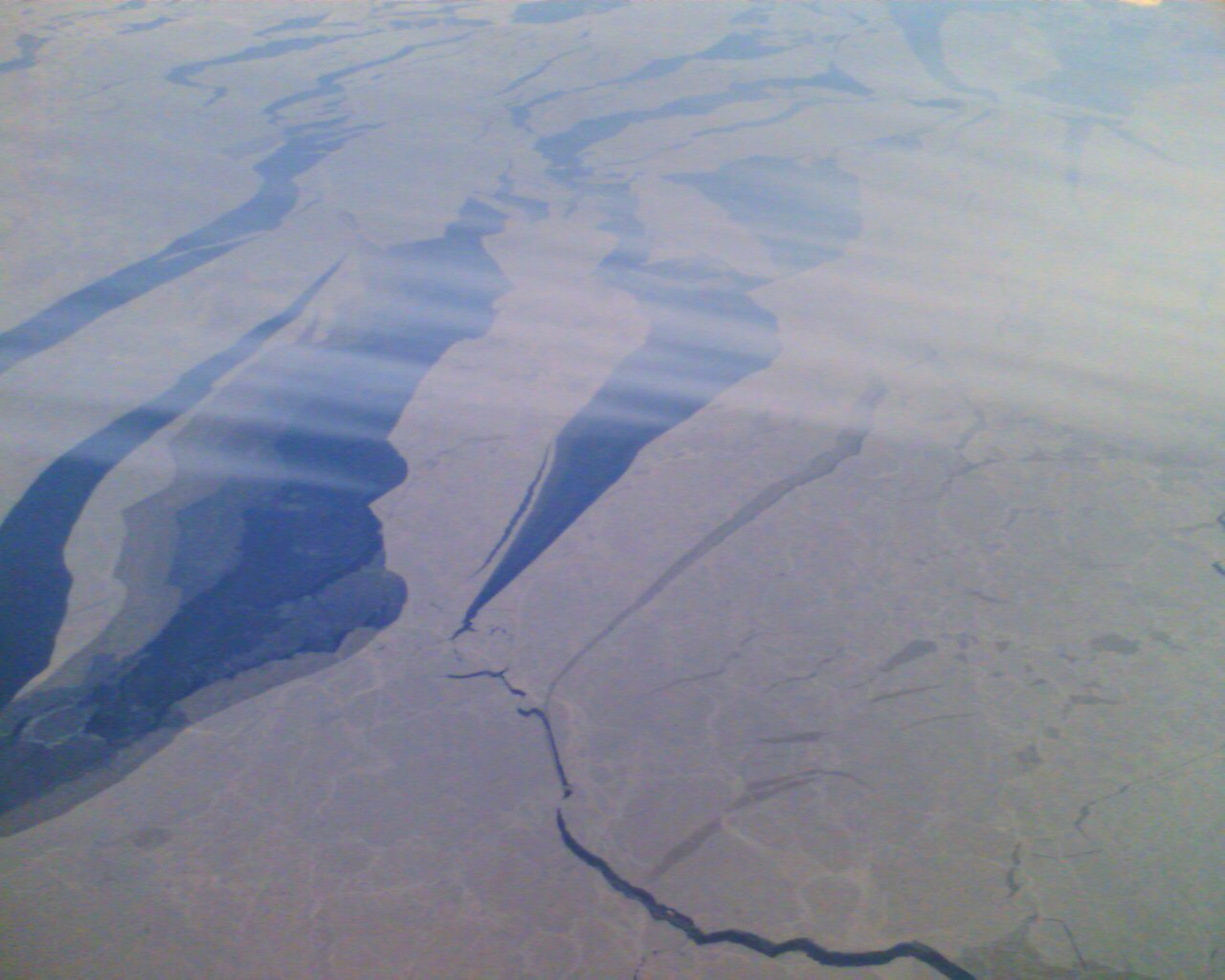
My flight to Hong Kong arch over the Bering Strait and the wilderness of Russia. I caught some incredible view of arctic sea ice. Click the pictures to see larger images.

2007.01.25 [] - comments (0)


Vietnam - Asia Trip 6/8

Hué

After a long day's travel from Laos, my arrival in Hué was rather dismal. Feeling tired from the toil from a full day of traveling, I arrived in an unfamiliar place late at night but still have not found a place to stay. I was very hungry. The only food I had for the entire day was the small breakfast of Laos pork bun in the morning. Moreover I did not have any local currency in my pocket. A cyclo driver has picked me up. Helplessly, I let him circle the streets to find me an hotel. I was not very pleased with the gloomy guesthouse I ended up in.

Just as you can fall into despair easily, you can also pull yourself out fast. I found a post office that was still open at night. I managed to change money from there and finally have cash to pay my driver. Then I found a better hotel myself on a more cheerful street and have switched there. There were many food stalls on the street where I had a chow. After a good night's rest, the next morning I asked the hotel host to teach me some basic Vietnamese. My spirit has all came back. I rented a bicycle next door and was ready to explore.

Hué Street

Hué was the imperial capital of Vietnam for a century and half until the World War II. Therefore it is endowed with many historical sights. The center piece is the citadel of the Forbidden Purple City. Unfortunately most buildings in the Forbidden Purple City were already destroyed in wars. I have paid US$5 entrance fee and found there were little more than souvenir shops inside. I should have just taken a picture in front of its front gate, which is perhaps the best preserved structure anyway.

There are a number of emperor's tombs outside of Hué, each costs $5 entrance fee. I have since gotten smarter. I have visited only the Tomb of Thieu Tri, which was admission free but not much different from other tombs. It turned out to be a dull and crumbling site.

Cycling in Hué was fun. I went out on the first day despite the rain. The second day was even better with wonderful weather. Riding a bike means conversations can start in unexpected place. Several times I have some locals spontaneously came to ride alongside, enthusiastically practicing their basic English with me. I was lost on my way to the Tomb of Thieu Tri. Despite the language barrier, people tried their best to give me directions. At the end they even pedaled with me for 20 minutes to bring me there. Having your own bicycle also greatly reduces the endless hassles from cyclo and motorbike drivers. They were all over the streets yelling at tourists and trying everything to get them on board. (Some still tried me no matter what).

I have enjoyed the Vietnamese food very much. They were cheap and tasty. One of my favorite is the Vietnamese French sandwich. I bought one intended to be saved as next day's breakfast before I have boarded an overnight train. But a warm sandwich in my hand was just too tempting. I ate half of my breakfast right away even before I got on board.

The train from Hué to Hanoi took 16 hours. As a foreigner I was charged a premium price on train tickets. This amount to 3 to 4 times the price of a comparable trip in Thailand. I booked the more affordable 'soft seat' ticket. It turned out 'soft' does not stand for upholstered as I expected. The seat was actually a plastic mesh mounted on wooden frame. It was an uncomfortable 16 hours. My neck was hurt afterward.

1996.10.12

Hanoi

Hanoi's tourist center is in the old quarter of the city by the Hoan Kiem lake. The busy streets are always jammed with people, cyclos and motorbikes. I arrived by cyclo to my hotel. It was a narrow old townhouse. The dormitory was a long room with 5 beds and a bathroom with a small balcony overlooking the street. A dormitory bed costs only $3 a day. The business was so new that it was not even listed in my guidebook. Nevertheless people found their way here. Right at my arrival, I ran into the British guy whom we walked from Laos to Vietnam together. I have also found Matsumi, the Japanese girl whom I first met in Nong Khai in Thailand. We would later traveled to Sapa together.

Unlike the tree lined boulevard where the president's palace and foreign embassies are located, the old town where I was staying is bustling and chaotic. Hawkers and peddlers were everywhere, especially targeting tourists. Cyclos drivers rode by and called at you to get on their cyclos. Crossing the street with a continuous stream of traffic was made more precarious by these unpredictable cyclos. Peace was hard to come by on the street on Hanoi.

Hanoi Street

Hanoi is the capital of Vietnam. The late leader Ho Chi Minh's mausoleum can be found in the northwest of the city. Outside are the National Assembly Hall and a square. The layout is reminiscence of China's Tiananmen Square but in a smaller scale. Somehow the sights of Vietnam always evoke China to me. The Forbidden Purple City and the tombs all feel familiar. The uncomfortable train and the two tier ticket pricing were what I have experienced in China. When I saw people brushing their teeth in front of their house on the street in the morning, it reminded me of the same scenery when I visited Guangzhou while I was very young. I felt like going back in a time machine and found a vision of China 10, 20 year ago.

The Ho Chi Minh's museum was a delightful surprise. At the first glance it shows uninteresting historical pictures of the communist party, a collection of outdated house ware like electric fans, hot water bottles and copper wire cables boasted as 'technology' achievement. Just as I am about to dismiss the museum as an outdated institution, I was unprepared to find the avant-garde art on the upper floors. There were modern sculptures, artistic photographies and molten glasses sculptures next to the narration of the struggle and glory of Ho Chi Minh. It was Uncle Ho with a modern art treatment. Voilà, Ho Chi Minh museum!

1996.10.18

Halong Bay

Halong Bay is in the east of Hanoi. It is a natural wonder with over 3000 small limestone islands of different size and shape scattering in the sea. I find it one of the most magnificent sights of Vietnam.

I have joined a 3 days tour to Halong Bay. Here in Hanoi, many tourist cafés are often doubled as tour companies. There offered various tours at very attractive price. My trip included bus transportations to and from the coast, 3 days and 2 nights on the boat with all meals and park admission, all for only US$38. We had 2 young tour guides on the trip. They were studying English degree in colleges and were working with the tour company part time.

Halong Bay

There were many other boats departing from the harbor at the same time. Fortunately Halong Bay is so big that we have soon spread out and hardly see others again. We have reached an island and anchored nearby. The water was clear and slightly warm. We wasted no time and dived and swam in the beautiful bay. Indeed people loved the sea so much that whenever the boat anchored somewhere, people started to bomb dived into water from the top deck right away.

At night, we anchored by a bay. Great food was served on board. Despite the cabins with beds are available, most people preferred to sleep on the top deck for the fresh air and the starry sky. It got so crowded that I can only find space in the middle deck and slept with other Vietnamese crews. In the midnight a rain spoiled the fun. They all have to rush back.

On the second day, we sailed to the Catba Island National Park. There we split up into two groups as planned. The larger group went directly to the beach. A smaller group with meself and a few others went hiking in the park. Our guide tried very hard to persuade us that the park is not worth going and that we should all go to the beach. We ignored his advice and found it very scenic and very interesting.

After Catba Island, we also explored a cave and climbed a hill on another small island. They are not so interesting compare to what we have seen before. One time there were two boats stopping on the same island. We had 40 people in all packed on a tiny hill top.

The trip was full of Francophone couples and unfortunately we did not get to mingle too much. I met 2 British guys though. They were quite impressed in the $3 bargain hotel I have stayed in Hanoi. So I bought two new customers back to the hotel after the trip.

1996.10.17

Sapa

Sapa is a charming hill town near the China border. Situated on a mountain range, it has the view of the highest peak in Vietnam. Below are some beautiful valleys where many Hmong minorities live and farm. The few days in Sapa has left me one of the fondest memories.

Matsumi, the Japanese girl I first met in Thailand, and I make this trip together. We took an overnight train to the border and continued from there by bus. The train was practically crawling in the first few kilometers out of Hanoi. Even old women on bicycles have passed us! The soft seat coach was just as uncomfortable as the one from Hué, except this time it took only 10 hours.

Sapa Bridge

We arrived in Sapa in a cold and rainy day. After all these time in tropical countries, this was my first taste of cold weather. Since there was not much to do, a couple of us in the hotel spent the day drinking local wine and playing cards. Fortunately the bad weather only lasted one day. Otherwise, we have joked we would have intoxicated by cheap wine.

The weather was perfect the rest of the days. We went trekking almost daily, first with Matsumi and a friend and later by myself. We went down to the valleys to see a waterfall and the wooden suspension bridges. The golden rice fields looked so beautiful under sunshine. The other days I went for much longer treks by myself. I went to some villages, climbed over a mountain and visited a distant waterfall. There wasn't any map to guide me. Instead I used mostly my instinct and sometimes a high vantage point to find my path.

Sapa farm kids

Saturday and Sunday is the market day in Sapa. Many Hmong minorities from around came into town to trade. Most of them were either young girls or old women. They were rather gentle and shy. Tourists also flocked into town and were charmed by the ethnic cloths and handicrafts for sale.

On Monday the town became much quieter. The minorities have left. The tourists have left. Even Matsumi has left. Nevertheless I have decided to stay in this peaceful town. Eventually I have extended the trip to six days. Still I have found company. I ran into a Japanese friend again. He love Sapa even more and has booked 10 days straight. We have shared an excellent home cooked dinner at his cozy guesthouse.

Also in the dinner with us was a British girl. She was traveling in the opposite direction of mine, coming from China into Vietnam. I have traded my Southeast Asia guidebook for her China guidebook. Since Vietnam was the last Southeast Asia country in my trip, it makes sense to trade it for something that was going to be more useful for me. But we both felt lost because the books meant something to us. Mine has been a faithful guide with me for two months. Hers has accompanied her across China and Tibet. Nevertheless, I hoped it will be useful for her trip. (China turned out to be one of the best part of my trip, in a large part thanks to her guidebook.)

* * *

Perhaps because it was my last days in Vietnam, I was getting sentimental. I have a thought came into mind. Isn't traveling means a series of farewell? You visited a place for a short time. Then you keep saying goodbye to people, to places, and even to objects (like my guidebook) the entire time. All that remain are perhaps some memories.

1996.10.24

Lao Cai

Next morning the bus departed from Sapa at 6:00am. It descended slowly down the mountains into the border town of Lao Cai. Since it was still early in the morning and the train for Kunming did not depart until the afternoon, I lingered in the Vietnam side. I have my last chance to savor my favorite Vietnamese French sandwich and beef noodles. When it was about time, I walked across the bridge and I was in China.

1996.10.25


2007.01.22 [, ] - comments (0)


Laos - Asia Trip 5/8

Vientiane

I have crossed the bridge into Laos with Matthew, whom I have met in Nong Khai. We have shared a room in Vientiane and traveled together. The capital of Laos is more like a provincial town. The city is uncrowded with only low rise buildings, small shops and quiet streets. Most of the city is small enough to reach by foot. Here you would not find any pushy vendors or persistent hagglers like those in Thailand. Instead you would find children playing on the street, sometimes greeting to passing by foreigners with "sawatdee". It is a far cry from other bustling cities in South East Asia. [more...]

2006.12.31 [, ] - comments (0)


Thailand - Asia Trip 4/8

Krabi

From Penang I headed toward the beautiful beaches of Thailand. Among the numerous destinations I have chosen the less traveled Krabi. The trip by minibus took 8 hours. But it required a few hours of layover in the border city Hat Yai. [more...]

2006.12.30 [, ] - comments (0)


Peninsular Malaysia - Asia Trip 3/8

Melaka

It was a long day traveling back from Sabah to Peninsular Malaysia. After 2 flights and 3 bus rides, I arrived in Melaka late in the evening. I did not have a hotel reservation by that time. But this was resolved quickly because the guesthouse people were gathering at the terminal snatching customers right off the bus. I was sent to a guesthouse that turned out to be a decent and clean place. [more...]

2006.12.29 [, ] - comments (0)


Sabah - Asia Trip 2/8

Mountain Kinabalu

I always enjoy the view from airplane. The coast of Borneo is covered by dense forests with winding rivers run between. Roads, houses and farmland are rather scarce until we flew further north. It is a largely undeveloped wilderness. [more...]

2006.12.28 [, ] - comments (0)


Goodbye Singapore - Asia Trip 1/8

It was 5:30 in the morning when I left the house. Last night my landlord insisted to take me out for a farewell dinner. After that we had a long talk. I did not start packing until it was very late. After half a bottle of wine from last night and very little sleep, my mind was surprisingly fresh in the morning. [more...]

2006.12.27 [, ] - comments (0)


A Journey Through Every Country In The World

I have posted my review for Lonely Planet's latest picture book "The Travel Book, A Journey Through Every Country In The World" on Amazon. I become the first reviewer!


Afghanistan, Albania, Algeria, Andorra, Angola, ... and continues on to the last country Zimbabwe, Lonely Planet has put together an extraordinary travel book that brings us to every country in the world. Listed alphabetically from A-Z, each country occupies 2 pages with vivid pictures and some impression of the lands. Even tiny Pacific islands get the same amount of space as everybody else, regardless of their size and popularity in tourism. Using a more liberal concept of 'country', it brings the total number to 230.

In just one volume, it makes no attempt to be a comprehensive reference book. Instead there are many fun ways to use it. Flipping it to a random page to get some inspiration for your next travel destination (you will likely end up in some distant place rather hard to get to.) Cover the title and try to name the country by the pictures alone (a challenging game given the pictures are more focused on people and landscape than instantly recognizable landmarks.) Or just read it cover to cover as I have prepared to do.

This book evokes the same kind of exhilaration from travelling. I was joyous like a kid while walking away from the bookstore with this 3kg book.

2004.09.20 [, ] - comments (2)


México Pictures

Just returned from vacation in Yucatn, México. We have a great time there enjoying music, antiquities, and sun and sea. Here are some of our pictures.

2003.11.28 [] - comments (0)


past articles »


BBC News


US eyes chance for Mid-East peace (09 Mar 2010)


Indian MPs approve women's bill (09 Mar 2010)


Prince fined over Kenya assault (09 Mar 2010)


Raids 'kill Indonesia militants' (09 Mar 2010)


Burma refugees 'face starvation' (09 Mar 2010)


Hard drive evolution could hit XP (09 Mar 2010)


'Ransom bid' in Cyprus body theft (09 Mar 2010)


US seeks Nigeria massacre trial (09 Mar 2010)


Chameleon's tongue beats the cold (09 Mar 2010)


Porn domain name plan resurrected (09 Mar 2010)

more »


Slashdot News for nerds, stuff that matters


Apple's iPhone Developer License Agreement Revealed (2010-03-09T14:40:00+00:00)


US Immigration Bill May Bring a National Biometric ID Card (2010-03-09T13:56:00+00:00)


50% Efficiency Boost From New Fuel Injection System (2010-03-09T13:14:00+00:00)


Making Sense of CPU and GPU Model Numbers? (2010-03-09T10:20:00+00:00)


NSA Still Ahead In Crypto, But Not By Much (2010-03-09T07:22:00+00:00)


Jobs Says No Tethering iPad To iPhone (2010-03-09T04:31:00+00:00)


Why Microsoft Can't Afford To Let Novell Die (2010-03-09T02:37:00+00:00)


AIDS Virus Can Hide In Bone Marrow (2010-03-09T00:42:00+00:00)

more »


TechPsychic Tech Rumors and Invented News


TechPsychic: Disclosure and as CEO job, NSFW. (09 Mar 2010)


TechPsychic: The HP Shows in the Nexus One Facebook iPhone iTunes link. (08 Mar 2010)


TechPsychic: Subscription rates, engineers, Socialcast which ended the Web Spends 8 Billion. (08 Mar 2010)


TechPsychic: Bing lets brands, is a long time. (08 Mar 2010)


TechPsychic: Twitter: Twitter's Chirp Conference: Job. (08 Mar 2010)


TechPsychic: Android Apps Bloom - a Hulu CEO David Rusenko says Twitter is. (07 Mar 2010)


TechPsychic: Microsoft CEO Talks The Future. (06 Mar 2010)


TechPsychic: Apple announced a beta Launch a status online is trying to which has. (06 Mar 2010)

more »


SF Gate


Proposed initiative aims at Muni drivers' pay (2010-03-09T08:07:24UTC)


Presented By: (09 Mar 2010)


Sixth Street says ooh la la to Passion Cafe (2010-03-09T08:22:54UTC)


Stanford considers bringing ROTC back (2010-03-09T08:07:29UTC)


Exploratorium gets million to prep for move (2010-03-09T08:22:54UTC)


Dad accused of shaking wailing baby to death (2010-03-09T08:07:13UTC)


Tow truck in S.F. rolls away, damages 10 cars (2010-03-09T08:07:04UTC)


Oscars 2010: Historic win for 'Hurt Locker' (2010-03-08T14:02:26UTC)


EU warns US against protectionism in Pentagon deal (2010-03-09T14:53:33UTC)


Amazon cuts off Colo. affiliates because of tax (2010-03-09T14:51:33UTC)


Stocks fall early on 1-year anniversary of low (2010-03-09T14:46:29UTC)


EU APNewsAlert (2010-03-09T14:38:29UTC)


Probe of PG&E meters to begin soon (2010-03-09T14:30:29UTC)


WuXi PharmaTech moves to 4th-quarter profit (2010-03-09T14:25:27UTC)

more »


Asia Times Online


Marjah, the city that never was (Tue 9 Mar 2010 19:00:00 +0700)


THE ROVING EYE : Oscar night in Baghdad (Tue 9 Mar 2010 19:00:00 +0700)


Atrocities may fill Iraqi power vacuum (Tue 9 Mar 2010 19:00:00 +0700)


SUN WUKONG : Limp arm of the body politic (Tue 9 Mar 2010 19:00:00 +0700)


'Bless you Mr Obama' on Myanmar (Tue 9 Mar 2010 19:00:00 +0700)


COMMENT : Alternative reading of Hamas murder (Tue 9 Mar 2010 19:00:00 +0700)


Politicians in bed with India's 'pimp gurus' (Tue 9 Mar 2010 19:00:00 +0700)


South Korea back on track (Tue 9 Mar 2010 19:00:00 +0700)


US ponders China's Southeast Asian rise (Tue 9 Mar 2010 19:00:00 +0700)


The great game - asset-trader style (Tue 9 Mar 2010 19:00:00 +0700)


THE BEAR'S LAIR : Accelerator jammed (Tue 9 Mar 2010 19:00:00 +0700)


THE MOGAMBO GURU : Supply-side madness (Tue 9 Mar 2010 19:00:00 +0700)

more »


Site feed Updated: 2010-Mar-09 07:15